The entry for information in the Oxford English Dictionary always makes good reading. It’s substantial: close to 10,000 words long. I see it has changed again. The last time I looked, the Number One definition was “The imparting of incriminating knowledge.” Excellent! As far as I’m concerned, they could stop right there. Of course, the relevant citations mostly came from...
Kids used to ask each other: If a tree falls in a forest and no one hears, does it make a sound? Now there’s a microphone in every tree and a loudspeaker on every branch, not to mention the video cameras, and we’ve entered the condition that David Foster Wallace called Total Noise: “the tsunami of available fact, context, and perspective.” This week was a watershed for Total Noise. When terrible...
In discussing memes in The Information, I quoted Daniel Dennett’s clever remark that a scholar is just a library’s way of making another library. If I had read Austerlitz, W. G. Sebald’s great and final novel, I would have added this: It struck me that the scholars, together with the whole apparatus of the library, formed an immensely complex and constantly evolving...
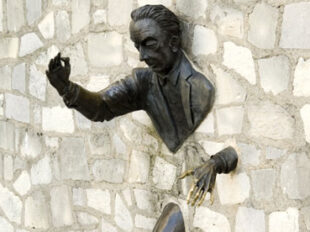
This is the weekend when the clocks do something—spring forward, it must be—and from now on Daylight Saving Time will always remind me of Marcel Aymé, born 111 years ago this month, a writer of “fantastic” stories, not much translated into English. I stumbled onto Aymé not via Twitter nor word of mouth nor any of the Intertubes but browsing in a bookstore, the kind with tables, on...
Having jotted the below item on Twitter and the Library of Congress, I belatedly rediscovered the following. Too easy to forget these things. From the wise and foresighted Steve Martin, 2008: [quote]I have learned that people are uploading their lives into cyberspace and am convinced that one day all human knowledge and memory will exist on a suitable hard drive, which, for preservation, will be...
[also at the NYR Blog] “What food for speculation each person affords, as he writes his hurried epistle, dictated either by fear, or greed, or more powerful love!” —Andrew Wynter (1854) For a brief time in the 1850s the telegraph companies of England and the United States thought that they could (and should) preserve every message that passed through their wires. Millions of...
Ada Byron, later Countess of Lovelace, was born 197 years ago, 10 December 1815, so it’s safe to say that many bicentennial preparations are already getting under way. What an unusual sort of celebrity she has become, after nearly two centuries of total obscurity. Let us remember: she was forgotten. Today she is the Google Doodle: For basic introduction, BrainPOP has a nice little...
Even misspelled, a certain word may not appear in The New York Times. So for those who cannot live without @scarthomas, the full version of my Autocorrect piece is here.