
Charles Babbage was born 220 years ago today—Boxing Day. Here is a little addendum for Chapter 4 of The Information, which contains a joint mini biography of the brilliant and misunderstood Babbage and the brilliant and doomed Ada Byron. This is due to Sydney Padua, an artist (“animator and cartoonist,” she says) in London, who is perhaps as enamored of Charles and Ada (and surely as...
Anyone interested in the relations between men and women (or any number of other topics) can get great pleasure from the day-by-day online version of The Diary of Samuel Pepys. It’s a soap opera. Especially at this moment (9 November 1668) and for the last few weeks (that is, 343 years ago). If you’re not up to date, Sam’s wife caught him in flagrante with her 17-year-old maid...
[quote]Indirect and abstract by its very nature, the telephone now seemed to be the positive symbol of my own situation: a means of communication which prevented me from communicating; an instrument of inspection which permitted of no precise information; an automatic machine, extremely easy to use, which nevertheless showed itself to be almost always capricious and untrustworthy.”[/quote]...
Here is a scholarly paper that caught my eye. It appears in the latest issue of the journal Information; the title is “Naturalizing Information”; the author is Stanley N. Salthe, a professor emeritus of biology from Brooklyn College. It attempts to create a better-than-ever, all-purpose definition of “information.” A meta-definition, perhaps I should say. Let me just quote the opening sentences:...
Just last month, in an essay for the New York Review, I wrote the following sentence about Google and secrecy: None of these books can tell you how many search queries Google fields, how much electricity it consumes, how much storage capacity it owns, how many streets it has photographed, how much e-mail it stores; nor can you Google the answers, because Google values its privacy. As of today...
Sitting at one’s desk in New York, one feels a tremor. Dreaming? Naturally one turns to cyberspace. The U.S. Geological Survey is reporting an earthquake just moments ago, but it’s in Virginia. That’s 300 miles from here—impossible. Or is it? The real-time seismograph from the Lamont-Doherty observatory is not responding. That in itself seems like a sign. Then there’s...
In a little essay in The Times (which you can read here or there) I muse about the differences between the artifacts of history—the tangible, venerable manuscripts and notebooks and other touchstones—and their new digital counterparts. I try to push back against what I see as a little bit of sentimentalizing. But nothing I say—and nothing I’m pushing back against—is as eloquent as a comment...
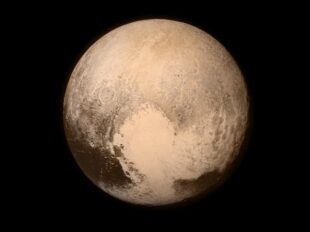
Hello, Pluto! But are you a planet? (What I wrote in 2011.)