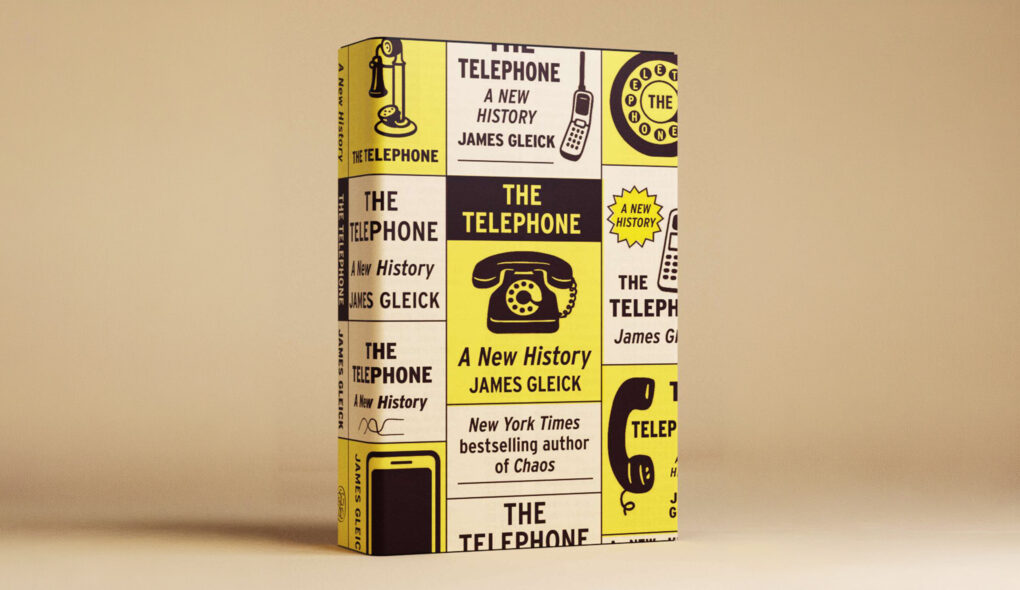
The Telephone is at once a history of an invention and much more than that. It’s a book about innovators and monopolists, tinkerers and geniuses, and, ultimately, the remaking—and re-remaking—of America. Science and technology never seem more exciting than when James Gleick is writing about them.”
—Elizabeth Kolbert, author of The Sixth Extinction: an Unnatural History
One hundred fifty years ago Alexander Graham Bell spoke the words “Mr. Watson—come here—I want to see you” into a contraption he called the telephone, and a voice was carried along a wire. This feat has long been celebrated as a triumph of individual ingenuity and vision. But its development was a contest replete with bribery and skulduggery, and no one, not even its inventors, realized what the telephone was good for.
It began a rolling revolution that has never ended. It would teach us new words (starting with the once-unfamiliar “hello”) and a new way to speak, with instant reaction, instant feeling, instant possibilities. It would create an all-female profession—the operator—that by 1920 outnumbered nurses and waitresses put together. It would enable the skyscraper, the world war, the assembly line, and the multinational corporation. And the Bell System would become the largest monopoly in history: the sole owner of every phone in America. The science that Bell Labs created around the telephone, from pulsing wires to glowing vacuum tubes to the electronic transistor, would usher in the Information Age.
Along the way, the telephone changed human nature. It augmented our bodies, a prosthetic extension of mouth and ear. It gave us the party line, the busy signal, dial tones, wiretapping, and the booty call. For a while, the revolution was so successful that it made telephones themselves seem natural, eternal. They settled into the background, on bedside tables, desks, and kitchen walls; in subways and on corners; in novels, movies, songs, and on TV. No one could remember life without them.
Today we are more dependent than ever on little objects called phones, although their ability to make “telephone calls” is incidental. The phone book and the phone booth may be vanishing from memory, but the telephone’s legacy is deeply ingrained—in our networks and our sophistication about networks, in the primacy of information, in the need for connection. The Telephone: A New History is a revelation: a story of technological breakthroughs that is also a universal history of intimate life.
Ultimately The Telephone is an answer to those philosophers who believe (with Octavio Paz) that “solitude is the profoundest fact of the human condition.” Gleick argues otherwise. The telephone makes the globe a community; it connects the disconnected. “Connection is the profoundest fact of the human condition.”
That little device in your pocket has transformed so much—Long-distance! Operators! The yellow pages!—into history. Who better to chronicle it all than the masterful James Gleick? From Bell and Watson to Steve Jobs, from patent wars to the evolving nature of conversation, Gleick charts our distance-compressing, time-shifting telephonic adventure with exceptional brio and subtlety.”
—Stacy Schiff, author of The Revolutionary: Samuel Adams